

You have to start somewhere, and the place to start keyword research is with what you already know about your business. You’ll use that to create a keyword seed list.
In the quest of creating an effective keyword strategy, I (Geraldine) will share three distinct methods for starting a seed list.
I encourage you not only to read through the strategies, but seriously try each method yourself. Finding the right keywords is experiential. It requires trial and error because sometimes what we think people search for, actually is not it.
By experimenting with these methods, you can customize them to suit your particular needs and uncover the winning combination of words that propels your online presence to new heights.
Now it’s time to play Keyword Jeopardy and discover the keywords that will make your business stand out!
Step 1: Brainstorming
Before using keyword research tools, however, you need to understand the thought process and intent behind keyword research. We covered intent in Chapter 1; now we’ll cover the thought process.
The first step is to decide which approach or method to use. Experiment with one or more of the three below to create your seed list. We’ll cover the remaining steps in the next chapter.
Eventually you’ll need to move your work to a spreadsheet, but you can start simply with a pen and paper. For now you’re just taking notes.
Download our free Keyword Research Workbook, which includes the tabs and columns you’ll need to brainstorm, organize, sort, filter, expand, refine, and analyze your keyword list in this and the next two chapters. In this chapter, we’re using the first two tabs.
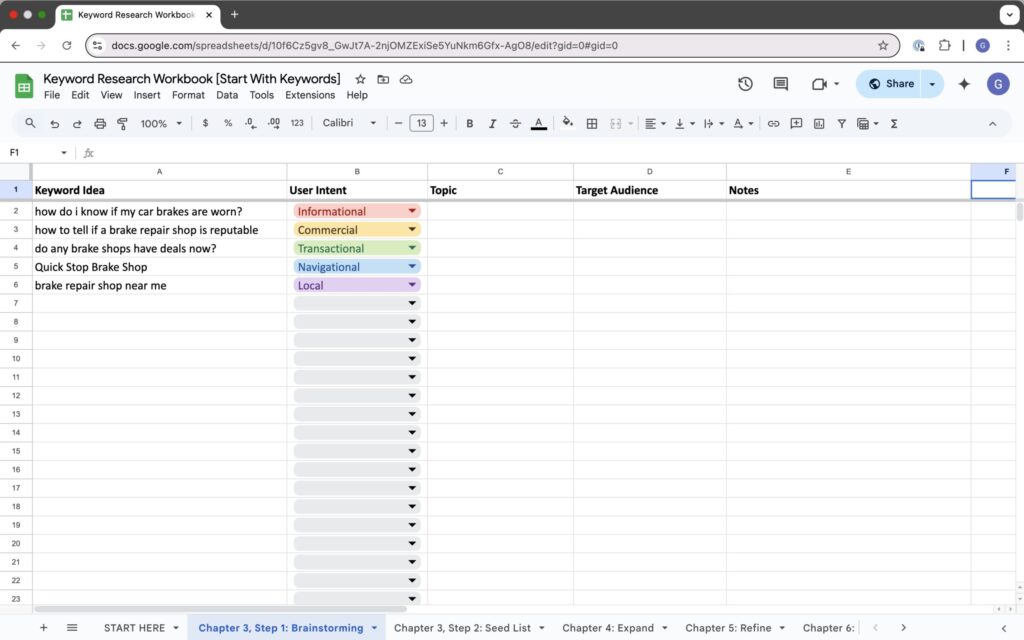
Screenshot of our free Start With Keywords workbook. Use it to create your own keyword list as you go through the steps in Part Two.
Method A: The 5 W’s and How?
Start by brainstorming words that relate to your business, customers, and products or services. I recommend writing your answers shorthand and in bullet points. This will make it much easier for the keyword research tools you’ll use later.
Who. These keywords represent your target audience groups that you came up with in the previous chapter. This is why you need to understand their demographics in detail: age, gender, income, etc. These are all starting points for further keyword research.
What. These keywords and phrases describe what you do. What are your products and/or services?
When. These keywords represent the time or time frame at which your audiences contact you. Immediately? While they’re on vacation? Before they get married? In local search, Google now up-ranks businesses during their hours of operation. (But don’t try to game the rankings by listing your hours as 24/7 if you’re only open 10am-6pm; that can get you suspended.)
Where. These are location-based terms: city, county, state, region, country, or something else. Write down your business locations, but also where your customers live, work, or would make use of your products or services.
Why. These are the keywords that people type into Google that are relevant to a site like yours. What pain points are you solving for them?
How. These keywords and phrases describe the benefits of your products and services or your process of working with clients.
You can use this method alone or with a business partner who knows the business as well as you do. Remember, you’re just brainstorming to start.
Method B: Question and Answer
With Method A, you start with what you already know. With Method B, you start by asking questions.
Question-and-answer is a powerful approach to crafting a comprehensive keyword strategy that resonates with your target audience. By delving into the queries and concerns of potential users, you can identify the specific phrases and terms they are likely to use when searching.
The first method you could do alone; Method B requires someone else. A good place to start is with your current clients, who will likely be happy to help—and have the distinct advantage that they already know your business. That makes them knowledgeable enough to ask follow-up questions and engage in deeper discussion.
Networking and referral partners are another good group to tap, for largely the same reasons. Supportive friends and family make up a third circle you can explore.
Here are the kinds of things you’re trying to find out:
- What are common questions that people ask about your business?
- What are the needs that people have in relation to your type of business?
- If someone were looking for your products or services, what words would they type into the search bar?
The last one is the basic, core question you’re trying to answer. But make your research more like a discussion than an interrogation. Remember, these people want to help you succeed.
Method C: Use Existing Data
Unlike the other two methods, this one tells you what people have actually asked, not what you think they will ask.
If your website has been around long enough and has Google Search Console and Google Analytics 4 installed, you can discover the keywords that are already getting your website into search results, eliminating guesswork.
Google Search Console provides a close look at how the site performs in Google’s search results. Most usefully, it shows which keyword searches returned the website in search results, and which words users clicked through to the website. You’ll get firsthand knowledge of exactly what they type into the search engine (even misspelled and grammatically incorrect words), and thus gain insights you can use to improve your content.
Google Analytics 4 offers detailed analytics on user behavior, traffic sources, and keyword performance over time. By examining how readers or shoppers move through your site, which sources drive the most traffic, and which actions people take (or not) on particular pages, you can gain valuable insights into what’s important to your audience. Google Analytics is structured very much along user intent, which we’ve been discussing.
In short, Search Console shows how people are finding your website in search results, while Analytics shows what they do when they get there.
Keyword discovery is a dynamic process, requiring assumptions, hands-on research, and trial and error. By experimenting with these techniques and immersing yourself in the intricacies of your audience’s search behaviors, you’ll be able to customize and refine your approach. Remember, what works for one business might not work for another, making it crucial to tailor your keyword strategy to suit your unique needs.
Step 2: Create a Seed List
Creating the seed list just means organizing the notes you took using the methods in Step 1, categorizing what you and others already know about your business. It doesn’t need to be long, merely to cover all the bases in a useful way. From there you can begin to discover.
Based on our experience, the co-authors find it useful to use something like the categories below to organize our seed lists. They provide a customer-centric range of opportunities for expanding the list, which we’ll cover in the next chapter.
Sort the words and phrases from your Step 1 research into the following areas:
- Brand
Words with your name, your brand name, and any other names that might be associated with the business.
- Location
Write down all the places you’re located and where you serve. Local businesses: Include cities, counties, or communities. National businesses may still target states or regions, so write those down.
- Customers
Include words and phrases describing the people you serve. Be specific. You should have this from your customer profiles and demographic research.
- Pain points and concerns
What problems are your customers facing and trying to solve?
- Solutions: Products and services
List your products or services by type or category, and also by name. Branded product or service names could be under item 1 if that makes more sense for your marketing key performance indicators (KPI)—the numbers such as sales, new customers, or margins that are important for measuring your business success. These may differ depending on your business type or personal preference.
- Unique Selling Proposition/Niche/Process
What is unique about your business? Your process? What do you specialize in? Break this up into three categories if necessary. Identify what sets your business apart. That could be exactly what someone is searching for.
If you haven’t downloaded our free workbook yet, now would be a good time. Start in Tab 1 (Brainstorming), then fill in the columns on Tab 2 for each category above. The tabs are all labeled to match the chapters of this book. You’ll need spreadsheets in Chapter 5 anyway, so you might as well take a minute now to set yourself up.
Steps 1 and 2 take some work but don’t need to be complicated. In the next chapter, we’ll expand your seed list using a variety of approaches, and then we’ll refine the expanded list after that.
Order Start With Keywords: The First Step to Ranking Higher on Google as a Kindle paperback or ebook.