
Who Are You?
This book is not for marketers; it’s for busy business owners who do their own marketing.
You may want to do it yourself—or you may not want to but need to, for any number of reasons. The reason doesn’t matter for our purposes here.
What matters is: You’re doing it yourself, or your in-house team is. You’re not hiring someone outside, like a professional marketer or agency.
This book will teach you.
What Is This Book About?
It’s about keywords. But what exactly is a keyword?
A keyword is simply the exact word or phrase that someone types into a search bar when they’re searching for information on a web browser or mobile device.
Exact word or phrase. There’s more to it than that, of course. But when we talk about keywords and keyword research, we’re talking about the specific words being typed into a search bar.
What you’ll get (like you’ve gotten countless times before) is a search engine results page (SERP) full of links to blog posts, videos, social media posts, and other types of informational content that contain the keyword you searched for. The art (and science and skill) of getting your own keyword-based content to appear higher on other people’s SERPs (and thus increase its likelihood of getting clicked) is called search engine optimization (SEO). We’ll explain all these terms as the book progresses.
Eventually, you’ll need to create that optimized, keyword-based content, which is the endgame of keyword research. But let’s not get ahead of ourselves; we’ll cover content in Part Three.
Keyword research sounds scarier than it is. The word “research” conjures images of tedious academic work, poring over arcane data until your eyes glaze over.
It doesn’t have to be that. Keyword research simply means figuring out which exact words and phrases people are actually typing into search bars.
In business terms, it means figuring out what questions people are asking when they’re looking for information, products, or services like yours.
There are many ways to do this; that’s what you’ll learn in this book.
Yes, you can get really deep into the weeds or lost in the forest or wherever you like to traipse. And if your business operates at scale, with hundreds of products, or publishes a dozen blog posts a day, then you almost certainly need a professional to get into the weeds for you.
Our purpose with this book is to really simplify it so that a busy business owner like yourself can get it done with minimal time and effort—so you can spend your time and energy running your business, which is what you’d rather be doing anyway.
Why You Should Care
Why should you care about keywords and keyword research?
Even if you’re paying someone to do your marketing, as a responsible business owner, you need to know how people are talking about your business. Specifically, how they’re asking about it, how they’re looking for it—so they find your business instead of your competitor’s.
Here’s the kicker. In our experience as agency owners, failure to do adequate keyword research is a major reason why search engine optimization (SEO) campaigns fail, and why so many business owners end up unhappy with their marketing agencies.
For now, just understand that SEO is about questions and answers—and who can answer questions about your business better than you?
Even if you’re hiring an agency, understanding keywords will help you understand what they’re doing even if you don’t know how they do it. After all, that’s what you’re paying them for. Understanding keywords will help you get your money’s worth.
How We’ll Do It (What’s In This Book)
Now that you know what we’re talking about and why, here’s how we’ll proceed:
First, this book is written by two people and we’ve made no attempt to try to sound like one person. We’ve each written particular chapters, and it’ll mostly be clear who wrote which, but it doesn’t matter. Geraldine and I (see, you already know who’s writing this) have worked together for several years on a variety of SEO and writing projects, so you’ll get the benefit of our combined experience and knowledge.
Part One
In Part One we lay out the basic elements of keyword research: words and people. Keyword research is all about people using words to ask and answer questions.
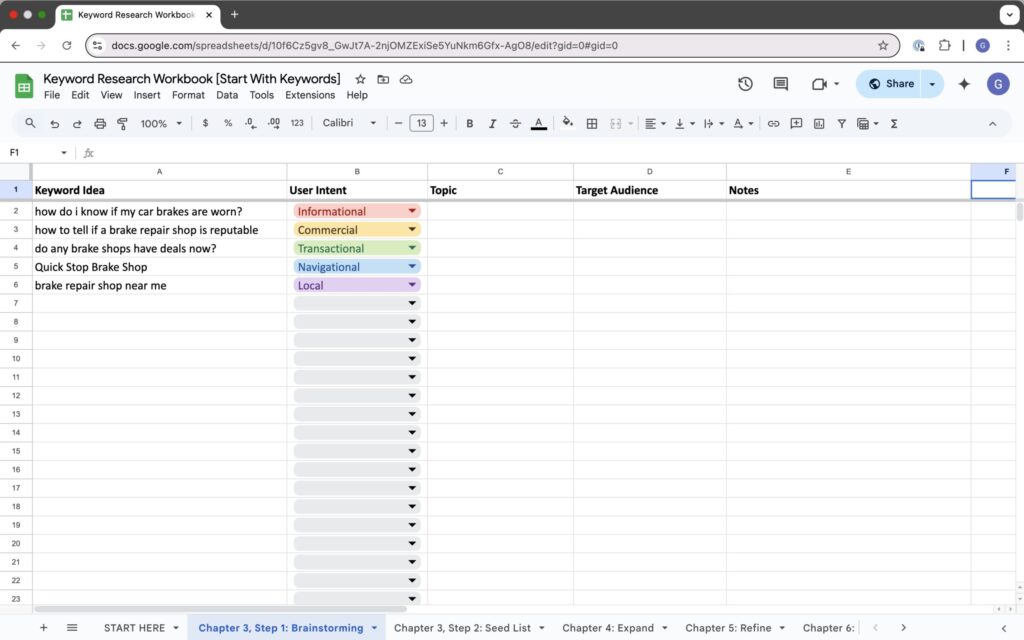
First, I will talk about the words. We’ll put keywords in context, and cover some types and definitions. Mainly, though, we’ll see how keywords relate to the all-important concept of user intent.
Next, Geraldine talks about the people: your audience. Or audiences; you may have more than one. They may find you in different ways and places, and be interested in reading about different things. Their interests may be common or unique, local or national or niche.
In short, by the end of Part One, you’ll have a basic but thorough understanding of who and what we’re dealing with, as well as a useful way to understand them.
Part Two
In Part Two we’ll put on our gloves and go through the actual process of keyword research.
You’ll learn how to create a seed list and then expand it using both free and paid tools. Then you’ll narrow it down, using metrics like search volume, relevance, and difficulty, as well as trends and seasonality.
By the end, you’ll have the basics of a keyword strategy, and we didn’t even need to call it that.
Part Three
In Part Three, we’ll cover several standalone topics, such as social media, local keywords, artificial intelligence (AI), and best (and worst) practices in SEO.
This is not a book about writing or creating content; that’s a book in itself, and others cover it thoroughly. But you will learn how to cluster keywords to create what Google calls helpful content—the gold standard in content marketing.
We’ll also talk about paid search (i.e. ads that you pay for), but paid search, like content creation, is a whole realm unto itself, so we won’t do more than introduce it to you here. Organic search is the realm of search engine optimization (SEO) and of this book. Paid search is the realm of search engine marketing (SEM).
Finally, what would a book like this be without a section full of Resources? We’ll cover our favorite tools and provide information on courses, downloads, and more to help you learn and improve.
Order Start With Keywords: The First Step to Ranking Higher on Google as a Kindle paperback or ebook.